Last updated November 25, 2026
Junior ADU or Full ADU: What Is the Difference?
A JADU looks like the cheaper, simpler answer on paper. Smaller footprint, lighter permit load, lower build cost. But a Junior ADU in Bellevue is legally required to share a wall with your primary home and to lean on the main house’s kitchen as a fallback. That single rule changes what you’re actually building: not a compact standalone home, but a studio apartment with one hand tied behind its back. The trade-offs run deeper than square footage, and most comparison articles skip them. This guide walks through the real difference between a JADU and a full ADU in Bellevue, from code requirements to rental math to what your lot can hold later.
Quick Answer
A Junior ADU (JADU) is a small attached unit, capped by state and city rules, that shares a wall with your primary home and can use the main home’s kitchen as a fallback. A full ADU is a complete, independent dwelling with its own kitchen, entrance, and typically its own utility meters, and it can be attached, detached, or built above a garage. JADUs cost less and clear permits with fewer requirements. Full ADUs cost more but rent higher and give you a genuinely autonomous living space.
Table of Contents
- What Is a Junior ADU, Exactly?
- What Is a Full ADU, and How Is It Different?
- Infrastructure: What a JADU Shares vs. What a Full ADU Owns
- Bellevue Rental Reality: What a JADU Can Actually Earn
- When a JADU Is the Smarter Financial Move
- How Bellevue Counts JADUs Toward Lot Limits
- Prefab or Custom: Choosing Your Delivery Path
- How Much Does Each Type Typically Cost?
What Is a Junior ADU, Exactly?
A Junior ADU is a small, attached residential unit carved out of or added onto an existing single-family home. Washington State law and Bellevue’s municipal code set the qualifying rules, and the definition is narrower than most homeowners expect. A structure only counts as a JADU if it meets specific size, attachment, and kitchen-sharing requirements. Get one detail wrong and the city treats it as a full ADU, which means you’re suddenly building to a heavier set of standards.
The core requirements look roughly like this:
- Attachment: A JADU must share at least one wall with the primary dwelling. It cannot be detached, and it cannot be a freestanding structure in the backyard.
- Size: A JADU is capped in square footage. The limit is set in code, not by preference, so the number is fixed before design starts.
- Kitchen: A JADU may contain a small efficiency kitchen, but it can also rely on the primary home’s kitchen as a fallback. That’s a livability concession baked into the definition.
- Entrance: A JADU may have its own exterior entrance or share the primary home’s entry, depending on how the unit is configured.
- Owner occupancy: This is the nuance most articles skip. Owner-occupancy rules for JADUs have evolved and can apply differently than they do for full ADUs. We confirm the current rule for each Bellevue property with the city’s planning department before plans are finalized, because getting this wrong can unravel a project after months of design work.
- Bathroom: A JADU must have its own bathroom, which means you’re still plumbing a wet wall, running a vent, and building a full interior fit-out.
Because a JADU lives inside or against the primary home, its permitting path is often less burdensome than a ground-up build. That lighter track is the whole reason JADUs exist as a category. But the concessions come with livability strings, and those strings have a direct effect on what you can charge for the space.
What Is a Full ADU, and How Is It Different?
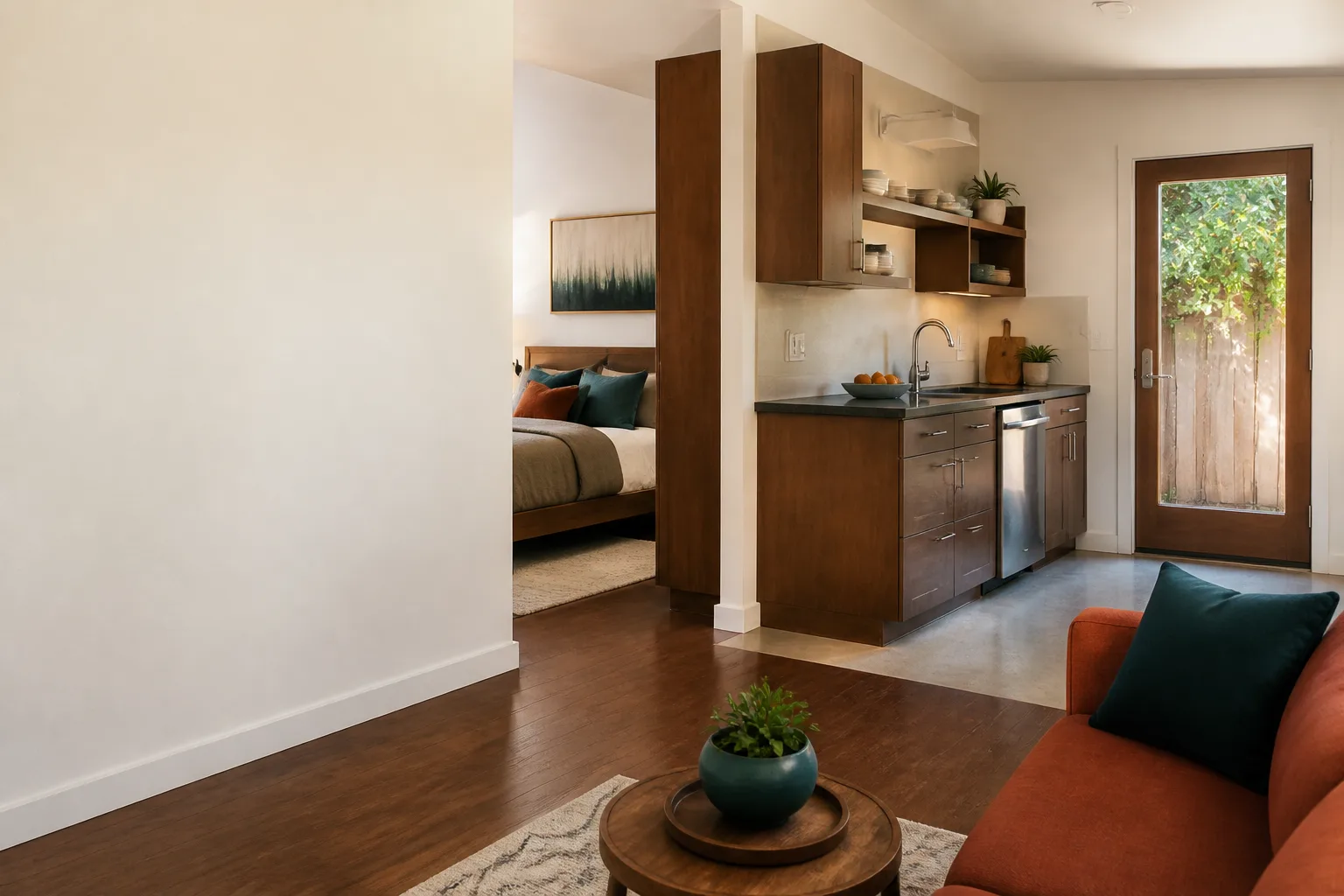
A full ADU, sometimes called a detached ADU, an accessory dwelling unit, or simply an ADU, is a complete dwelling unit on its own. It has its own kitchen, its own bathroom, its own entrance, and its own kitchen-living arrangement. It can take one of four shapes, and the shape you pick drives cost, timeline, and livability:
- Detached new build: A ground-up structure in the backyard, fully independent of the primary home.
- Attached addition: A new wing or an above-garage unit that shares a wall or roofline with the primary home but has its own full kitchen and entrance.
- Garage conversion: An existing garage transformed into a complete dwelling. This is one of the most cost-effective paths, and a garage conversion often reuses the existing foundation and roofline.
- Basement or interior conversion: An existing below-grade or interior space made into a full, independent unit.
The critical difference from a JADU is autonomy. A full ADU doesn’t share a kitchen with the primary home and doesn’t need to share a wall. It can be metered independently, entered independently, and leased independently. For a homeowner planning to rent the space long term, that autonomy is the entire product. For a homeowner building for a parent or adult child, the same autonomy is what makes multigenerational living actually work without friction.
Full ADUs also face more code scrutiny. Detached structures trigger planning review on setbacks, height, and lot coverage, and the utility connections have to be designed from scratch. We confirm every rule with Bellevue’s planning and building departments before plans are final, because the rules depend heavily on the specific lot and the specific zoning district.
Infrastructure: What a JADU Shares vs. What a Full ADU Owns
This is where the JADU vs. ADU decision stops being about square footage and becomes about plumbing, wiring, and meters. What the unit must have on its own, and what it can borrow from the primary home, drives both your build budget and your tenant’s experience. Here’s how the two compare in practice:
- Kitchen: A JADU may contain a small efficiency kitchen, but it can also share the primary home’s kitchen as a fallback. A full ADU must have a complete, independently functioning kitchen (sink, range, refrigerator, dedicated counters).
- Bathroom: Both need a private bathroom. This isn’t a differentiator; expect full plumbing work either way.
- Entrance: A JADU may share the primary home’s entry or have its own. A full ADU must have an independent entrance.
- Utility meters: A full ADU is typically metered separately for electricity and gas, so the tenant can hold utilities in their own name. A JADU usually rides on the primary home’s meters, which means you’re absorbing utility costs or splitting them by agreement. That’s a real ongoing friction point in a rental relationship.
- HVAC: A JADU may tap the primary system or have a dedicated mini-split. A full ADU needs its own heating and cooling design, sized to the structure.
- Water heater: A JADU may share the primary home’s unit. A full ADU typically needs its own, sized to the unit’s fixtures.
- Sound separation: A JADU shares a wall with the primary home, and sound transmission through that shared wall is a livability issue no permit review evaluates. A full ADU, attached or detached, gives you more design control over acoustic separation.
Each of those “shares” line items saves you money at construction but costs you something later: utility complexity, tenant screening difficulty, or a livability compromise. When we design a JADU in Bellevue, we pay close attention to the shared-wall acoustic detail, because it’s the single biggest predictor of whether an owner and a tenant can coexist comfortably in a shared-wall arrangement.
Bellevue Rental Reality: What a JADU Can Actually Earn
A JADU will rent for less than a full ADU in Bellevue, and the gap is larger than most homeowners expect. The reasons aren’t mysterious. Renters shopping in Bellevue compare units on privacy, kitchen access, and utility simplicity. A JADU compromises on all three.
Here’s how the shared-wall nature plays out in the real rental market:
- Tenant screening narrows: A JADU’s shared wall means the tenant and the owner are effectively neighbors. You’ll need to screen for someone comfortable with a shared-wall living arrangement, which steps out a larger share of the applicant pool than a detached unit would.
- Lease terms skew shorter: JADU tenants often treat the unit as transitional. A full ADU, with its own kitchen and meters, attracts renters looking to stay longer, which reduces turnover cost.
- Utility arrangements complicate the lease: If the JADU rides the primary meters, you either build utilities into the rent (which reduces the headline number) or split them by agreement (which requires trust and is hard to enforce).
- Kitchen fallback caps the rent: A renter who expects a full kitchen won’t pay what a full ADU commands, and they’ll filter out of your applicant pool early.
- Rent ceiling rises with autonomy: Every independently metered, independently entered, fully equipped unit moves up the Bellevue rent scale. A JADU’s shared infrastructure holds it lower.
The upshot: a full ADU typically carries a higher build cost but a materially higher rent, and the rent premium tends to be durable because it reflects structural differences no landlord can upgrade away. When we run the numbers for a Bellevue homeowner, we compare projected rent in Bellevue by unit type rather than assuming one is universally better. The right answer depends on whether you’re optimizing for lowest entry cost or highest long-term yield. If a full ADU is the goal, working with experienced ADU builders from design through construction is what keeps the timeline honest.
When a JADU Is the Smarter Financial Move
A JADU is the right call when the constraint is capital and complexity, not rental income. There are specific scenarios where the lower build cost and faster permit track more than offset the livability and rent-ceiling trade-offs. If any of these describe you, a JADU belongs on the table:
- You’re housing a family member, not renting. A parent, an adult child, or a returning family member gets a dignified private space, and the rent ceiling stops mattering because you’re not renting to a stranger. The shared kitchen is often a feature in this case.
- Your lot is tight. If setbacks, lot coverage, or slope make a detached structure difficult, a JADU carved from the existing footprint avoids those constraints entirely. On a constrained Bellevue lot, that can be the difference between a project that pencils and one that doesn’t.
- Your garage or attic is underused. A junior ADU built into an existing structure can reuse foundation, roof, and utilities in ways a detached build cannot.
- You want to test the ADU model before going bigger. A JADU lets you get a rental unit on the property without committing to a full detached build. If the arrangement works, you can explore adding a full ADU later, subject to lot limits (more on that below).
- You want to shorten the permit path. The lighter permitting track for JADUs isn’t a guarantee of speed, but it is a lighter review. Every step you skip is a step that can’t delay your project.
Notice what’s not on that list: “you want the most rental income.” A JADU is the smarter financial move when the goal is affordability, family housing, or incremental property value, not when the goal is maximizing rent. We’ve seen the JADU-vs-ADU question go sideways when a homeowner builds a JADU hoping for full-ADU rent, and the gap gets built in from day one. If maximizing rental income is the goal, a full ADU is almost always the better fit, and that’s true whether you go custom or work with a prefab brand like Cover or Dvele.
How Bellevue Counts JADUs Toward Lot Limits
Here’s the question almost no comparison article answers: does a JADU count against the number of ADUs you’re allowed to have on a lot? In Bellevue, yes, and that matters because it can affect whether you can add a full ADU later.
The general picture: Bellevue, like most Washington cities operating under state direction, permits more than one type of ADU on a qualifying single-family lot, and a JADU counts toward those limits. The specific numbers depend on the lot, the zoning district, and current code, and the rules change more often than homeowners assume. That’s exactly why we confirm every limit with the city before design starts. Getting the count wrong costs far more after you’ve drawn plans than before.
The practical takeaway is this: if you build a JADU now with the intention of adding a full ADU later, check the lot limit first. On some lots, a JADU and a full ADU can coexist. On others, the JADU consumes the allowance and a full ADU later isn’t possible without removing the JADU. If a full ADU is in your future plans, that’s a critical piece of due diligence to complete before you commit to the JADU route.
Owner-occupancy requirements add a second layer. A JADU’s owner-occupancy rule can differ from a full ADU’s, and the two can affect each other when a property has both. We confirm the current rules with Bellevue’s planning department on every project, because the answer determines what you can build and what you can rent. When a homeowner is planning a multi-unit property, we run through those rules up front rather than discovering them mid-review. That’s part of what full ADU design and permit services means in practice: the painful part gets handled before it becomes a delay.
Prefab or Custom: Choosing Your Delivery Path
Once you’ve decided whether a JADU or a full ADU is the right fit, the next decision is how to build it. For full ADUs in particular, there are two main delivery paths: a prefab unit built in a factory and assembled on site, or a fully custom site-built structure. Each has real advantages, and matching the path to your lot, budget, and timeline up front is what keeps a project on track.
- Prefab ADUs: Factory-built units from brands like Cover and Dvele arrive as finished components and assemble on site. The advantages are schedule predictability and a fixed design, because the unit is engineered and tested as a system. Prefab tends to shine when your lot is straightforward, your design preferences are flexible, and schedule reliability is your priority.
- Custom site-built ADUs: A structure designed and built specifically for your lot and your needs. Custom shines when setbacks are irregular, when you want a specific architectural match to the primary home, or when the unit’s layout has to work around existing utilities or landscaping.
- The consultative middle: The honest answer for many Bellevue homeowners is that the right path depends on the site. The advantage of a team that works with both prefab and custom is that you get an apples-to-apples comparison before you commit, not a sales pitch for one method.
Prefab brands are a real asset here, and working with Abodu, Cover, and Dvele gives homeowners a proven factory-built option alongside custom builds. But prefab isn’t universally the better choice, and any honest review of both paths will tell you that. If you’re leaning toward custom, a home addition can serve the same goal as a full ADU when the lot makes a detached structure difficult.
How Much Does Each Type Typically Cost?
Cost is where the JADU vs. ADU comparison gets uncomfortable, because exact numbers depend so heavily on site, systems, and finish level. We don’t quote a price before we’ve seen the lot, and neither should anyone else. What we can give you is the shape of the price difference, by category, so you can plan:
| Cost Category | Junior ADU (JADU) | Full ADU |
|---|---|---|
| Foundation and framing | Typically lower: reuses or shares the primary structure | Typically higher: new foundation, full framing |
| Kitchen | Small efficiency kitchen, may share primary kitchen | Full independent kitchen required |
| Utilities and meters | Usually shares the primary home’s meters | Independently metered; separate hot water and HVAC |
| Entrance | May share the primary entry | Independent entrance required |
| Permit path | Lighter review track | Standard (heavier) review track |
| Design and construction | Estimated lower total cost | Estimated higher total cost |
The pattern to note: a JADU is estimated to cost less on almost every line, and the biggest savings show up in foundation and utility work. A full ADU’s higher cost reflects the home-du-jour difference: independent systems, independent entry, fully independent kitchen. Those systems are what let you charge higher rent and screen some tenants out. When you get a written estimate from us, every line item is spelled out, so you can compare a JADU and a full ADU on your Bellevue lot side by side before committing.
Common Mistakes to Avoid
- Assuming a JADU is just a smaller ADU. A JADU isn’t a scaled-down detached unit; it’s a structurally different product with share-a-wall and shared-kitchen rules. Read the definition carefully before you design a floor plan.
- Skipping the owner-occupancy check on a JADU. The owner-occupancy nuance for JADUs can differ from a full ADU’s, and missing it can change what you’re allowed to do with the unit. Confirm the rule with the city before you build.
- Building a JADU, then planning a full ADU without checking the lot limit. A JADU can count toward Bellevue’s ADU limit for your lot, which could block a future full ADU. If a full ADU is part of your long-term plan, do that due diligence first.
- Undersizing the AC. A detached ADU in the Puget Sound climate needs a heating and cooling system sized to the structure and the shading, and reusing the primary home’s system for a detached unit rarely works. Size the system for the unit.
- Underestimating the shared-wall sound problem. A JADU’s shared wall is the single biggest livability compromise. If you go the JADU route, budget for acoustic separation in the wall assembly, not just insulation.
- Forgetting you need a bathroom either way. A JADU still needs its own bathroom, which means plumbing, venting, and full interior work. The JADU savings are in the kitchen and utility sharing, not the bathroom.
- Assuming permits will be fast because a JADU’s path is lighter. A lighter review track doesn’t guarantee a timeline. The schedule is set in the written estimate, and a third-party permit run can delay a project for reasons that have nothing to do with your design.
When to Call a Professional
Call us before you’ve committed to a design, not after. The JADU vs. ADU decision is a code question, a lot question, and a rental math question all at once, and each of those needs an on-site look before it can be answered honestly. Specifically, call us if any of these are true:
- You’re not sure whether your lot qualifies for one unit or both, and you want a straight answer before spending on design.
- You’re building a JADU for a family member and need the bathroom, kitchen, and shared-wall details worked out correctly.
- You’re comparing prefab and custom and want an apples-to-apples comparison instead of a single-method sales pitch.
- You’ve got a garage that could become a full ADU and you want to know whether that’s easier than a JADU.
ADU Builder Bellevue offers free estimates in Bellevue; call (425) 699-8731 to schedule yours. We answer 24/7. Fast dispatch from 7am to 7pm, Sunday through Friday.
Frequently Asked Questions
A JADU is typically estimated to cost less than a full ADU in Bellevue, mainly because it reuses the primary home’s structure, shares utility meters, and can rely on the primary kitchen. The savings show up biggest in foundation, framing, and utility work. For an exact comparison on your lot, call (425) 699-8731; estimates are free.
Sometimes, but it depends on your lot, zoning district, and current city code, because a JADU can count toward the ADU limit. The safest approach: confirm the limit with Bellevue’s planning department before you design either unit. If a full ADU is part of your future plan, call (425) 699-8731 to walk through the options before you commit.
A JADU must have its own bathroom, but its kitchen can be a small efficiency setup and may rely on the primary home’s kitchen as a fallback. A full ADU must have a complete, independent kitchen plus its own bathroom. Call (425) 699-8731 to talk through which layout fits your plans.
A JADU typically rents for less than a full ADU in Bellevue, because shared walls, shared meters, and the kitchen fallback narrow the renter pool and cap the achievable rent. A full ADU’s autonomy lets it command more. For a rental comparison on your property, call (425) 699-8731.
Yes, but the order matters. A JADU can count toward your lot’s ADU limit, so if a full ADU is in your long-term plan, we check that limit before design starts. From blueprint to building permit to move-in day, we handle the design, permit, and construction phases together so nothing gets lost between them. Call (425) 699-8731 to start.
It depends on your lot and priorities. Prefab units from brands like Cover or Dvele offer schedule predictability, while custom builds suit sites where setbacks are irregular or the design needs to match the primary home. We work with both paths and can compare them side by side. Call (425) 699-8731 for a free estimate.
The Bottom Line
The JADU vs. ADU decision comes down to one question: how much autonomous living infrastructure do you actually want to build? A JADU shares a wall, can share a kitchen, and rides on the primary home’s utilities. It’s the smarter financial move for family housing, constrained lots, and lower entry costs. A full ADU owns its systems, commands higher rent, and gives you a genuinely independent unit. Both are legitimate paths, and Bellevue’s code treats them differently enough that the choice has real consequences. We build one thing, and we build it right: if you’re ready to move from comparison to design, call (425) 699-8731 and get a free estimate on your Bellevue property. We answer 24/7. Fast dispatch from 7am to 7pm, Sunday through Friday.
Ready to see what’s possible on your lot? Reach out to ADU Builder Bellevue for a free estimate. Our technicians have up to 14 years of experience, and we handle permits, design, and construction under one roof.
Related Reading
- Garage conversion: a cost-effective path to a full ADU in Bellevue.
- Junior ADU: how JADUs are designed and permitted in Bellevue.
- ADU design and permit services: how we handle the painful approval process for you.
- ADU cost factors in Bellevue: what drives price on every project.
- Prefab vs. custom ADUs: choosing the right delivery path for your lot.
- ADU builders: our full range of ADU construction services.
Written by the team at ADU Builder Bellevue.